
The Instagram Reels algorithm has become, in 2026, the main lever of organic visibility on the platform. Understanding how it works, what it favors, and what it penalizes is no longer optional for creators, brands, and entrepreneurs who want to truly grow. According to data shared by Adam Mosseri, more than 50% of time spent on Instagram is now devoted to Reels, confirming that the platform is fully betting on this short vertical format to compete with TikTok and YouTube Shorts.
In this complete and up-to-date guide, we break down the signals that drive Reels ranking, the traps to avoid, the best practices validated by recent studies, and the way a targeted amplification strategy can help your content cross the critical first few hours where the algorithm makes its most important decisions.

What does the Instagram Reels algorithm actually do in 2026?
Contrary to popular belief, Instagram does not use a single algorithm: the platform relies on multiple ranking systems tailored to each surface, and the Reels one is arguably the most sophisticated. Its mission, explained in Instagram’s official documentation, is to surface, for every user, the short videos most likely to hold attention, trigger an interaction, and extend the session.
To do that, the system combines hundreds of signals and estimates, for each user-video pair, several probabilities: probability of full viewing, probability of a like, probability of a DM share, probability of a save, and probability of a profile visit. These predictions are aggregated into a ranking score, and the top-scoring Reels rise to the top of the dedicated feed, the Explore tab, and even the main feed as recommendations.
The 4 main signals the algorithm analyzes
Rather than following a single recipe, the Reels algorithm groups its signals into four families that every serious creator must know:
- The user’s interaction history: who they DM, which accounts they visit, which Reels they liked, shared, or saved in the last 90 days.
- The video’s characteristics: duration, image quality, audio used, on-screen text, topic detected by Instagram’s vision and language models.
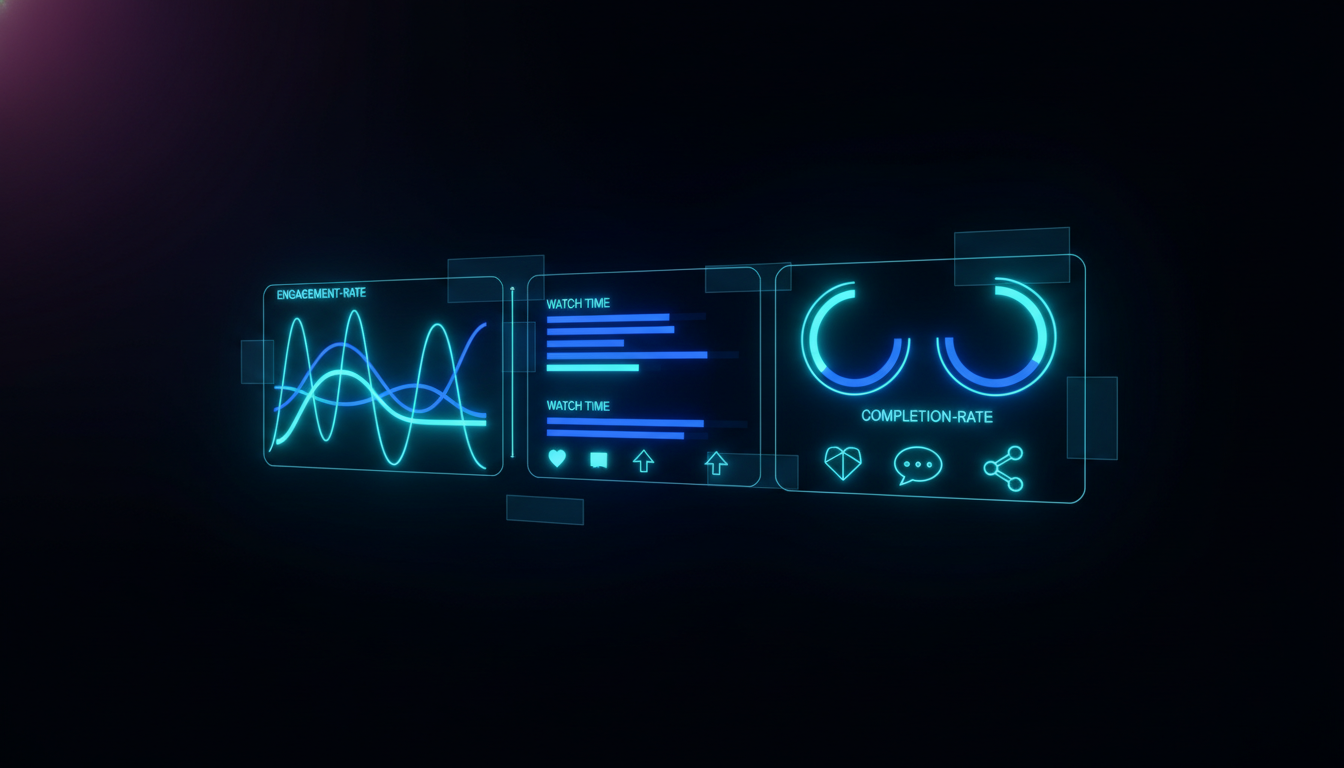
- Early engagement signals: completion rate, share-to-view ratio, speed at which first viewers react.
- Creator characteristics: posting cadence, topical consistency, average engagement rate over the last 30 days.
As confirmed by a recent Hootsuite analysis, no single signal is enough to push a Reel: it is their combination, and especially their consistency, that triggers the snowball effect.
Watch time: the number-one factor
If we had to rank the signals by importance, watch time would sit at the top. The Reels algorithm massively prioritizes videos that hold attention to the very end, and even more those viewers rewatch in a loop. A study published by Social Insider shows that a Reel with a completion rate above 90% is roughly three times more likely to be recommended than one with a 50% completion rate.
Concretely, the first seconds are decisive. A strong hook, a clear promise, an intriguing question, or a visually striking opening shot in the first two seconds can multiply your views tenfold. To go further, see our dedicated guide on boosting Instagram Reels views.
Engagement rate: likes, shares, saves
In second place, post-watch engagement plays a decisive role. The algorithm tracks four main interactions and assigns each a different weight:
- DM shares are the strongest signal. A Reel shared in DM is interpreted as content valuable enough to recommend to a friend.
- Saves rank second: they show the video has reference value (tutorial, tip, recipe, comedy gem).
- Comments feed the algorithm with semantic signals: the longer the conversation, the more the Reel is judged relevant.
- Likes remain a positive signal, but their relative weight has dropped in 2026 in favor of the three previous interactions.
To dig deeper into shares, read our analysis of DM shares as a key new signal. For practical engagement tips, see also our six tips to grow Instagram likes.
Posting frequency and topical consistency
An account that posts a Reel every three weeks, on a different topic each time, sends the algorithm a fuzzy signal. Conversely, an account that publishes four to five Reels per week around a tight theme becomes quickly recognizable. The algorithm learns to associate that profile with a target audience and distributes it more effectively.
According to 2026 data published by Later, accounts that publish four or more Reels per week see their organic reach grow by 36% on average compared to those that post once a week. Regularity builds algorithmic trust, and that trust is what unlocks massive recommendations. See also our guide on the best days and times to post on Instagram.
Audio, hashtags, and visual keywords
Instagram also analyzes the audio track of your Reels. Using a trending sound can multiply reach by two to five during the peak phase, because the system associates your video with all other videos using that same audio. Adam Mosseri confirmed it: an emerging sound acts as a discovery accelerator, provided the content stays consistent with what the audio’s usual viewers like.
Hashtags are no longer the main discovery channel they were in 2020, but they still help the algorithm classify your content. Three to five relevant hashtags beat a flood of generic ones. Instagram’s computer vision system also reads visual elements (objects, locations, people, on-screen text) to refine the topical classification.
Why your Reels stagnate (and how to break free)
Many creators see their Reels stuck around 200 to 500 views, never taking off. When that happens, three causes come up over and over:
- A slow start: if your video does not get around fifty interactions in the first hour, the algorithm stops pushing it to new audiences.
- A confused audience signal: your account targets one audience but the Reel speaks to another, which confuses the system.
- A fragile account: few active followers, little history, a structurally low engagement rate.
To dig into these points, read our article on the seven reasons your Reels are not seen and our overview on how to please the Instagram algorithm.
The concrete levers to boost your Reels in 2026
Here are the actions that make the biggest difference, ranked by impact:
- Optimize the first two seconds: close-up face, motion, impactful text, question, value promise.
- Build a natural loop: the end of the Reel connects to the beginning, which boosts watch time and completion rate.
- Encourage shares and saves with a discreet call to action at the end ("send this Reel to a friend who...").
- Post when your audience is active, usually 11 AM to 2 PM or 7 PM to 9 PM depending on your geography.
- Reply quickly to comments in the first thirty minutes: every reply creates a new conversation and sends a positive signal.
- Maintain a cadence of four to five Reels per week, three minimum.
- Use a trending audio on the days it climbs, without losing your editorial identity.
For a complete view on organic growth, see our deep dive on how to reach 1,000 Instagram followers quickly and the reference guide published by HubSpot on the Instagram algorithm.
How targeted amplification helps your Reels cross the critical threshold
The Instagram algorithm works in tiers: if your Reel reaches an interaction threshold within the first sixty minutes, it gets exposed to a wider circle; otherwise, it is frozen. For creators who are starting out or restarting an account after a quiet period, that threshold is often unreachable purely organically.
That is where our Reels views amplification offer comes in. Our views are delivered through steady traffic, starting at 0.03 € per 1000 views, with Anti-Loss Guarantee recovery over 30 days for the eligible tiers. The goal is not to inflate a counter artificially: it is to give your Reel the starting credit it needs to clear the initial evaluation tier.
The same logic applies to Instagram likes, starting at 0.21 € per 1000, and to Instagram followers with Anti-Loss Guarantee, starting at 3.90 € per 1000. The combination of these three levers, dosed wisely and applied to careful content, accelerates the learning phase the algorithm runs on your account. The official figures compiled by Statista remind us that Instagram has over 2.4 billion monthly active users: competition is fierce, and any help to clear the early tiers counts.
Common mistakes that quietly kill your reach
Some behaviors silently penalize Reels distribution without you knowing:
- Reposting a TikTok video with the watermark still visible: Instagram reduces the reach of Reels that contain a competitor’s watermark.
- Using a low-resolution or horizontal video: the native format is 9:16, fullscreen.
- Posting ten Reels in a row in one hour: the algorithm starts pitting them against each other.
- Suddenly switching niches: going from cooking to gaming in a week erases your account’s topical signature.
- Buying ghost followers that unsubscribe within a few days, which collapses the engagement-to-follower ratio.
This last mistake is exactly why we exclusively offer formulas with an Anti-Loss Guarantee on sensitive Instagram services: for 30 days, lost followers are automatically replaced, preserving the statistical health of the account.
How long until the Reels algorithm plays in your favor?
Data accumulated on the accounts we support shows a remarkably stable pattern: it usually takes four to six weeks of regular publishing (four Reels per week minimum) for a fresh account to enter a clear algorithmic growth phase. Before that, the algorithm lacks the data to evaluate your content precisely and identify your core audience.
During that learning phase, two metrics matter most: the average completion rate (aim above 65%) and the shares-to-views ratio (aim above 1%). If both progress week after week, you are on the right track, and a targeted amplification boost makes full sense.
As your editorial cadence settles in, you should see a stronger presence in the Explore tab and more appearances in recommendations. Those signals confirm the algorithm is now actively distributing your content to qualified audiences.
Conclusion: align your Reels with what the algorithm rewards
The Instagram Reels algorithm in 2026 is neither mysterious nor capricious: it rewards content that holds attention, that gets shared, that gets saved, and that fits a clear editorial cadence. The good news is that all those signals are within reach if you work on your hook, your format, your consistency, and your audio.
When the content is solid but the start lacks fuel, measured amplification breaks the critical tier. That is exactly what our Instagram services deliver: a calibrated boost shipped with Anti-Loss Guarantee, to turn a promising Reel into a Reel that actually gets seen.